
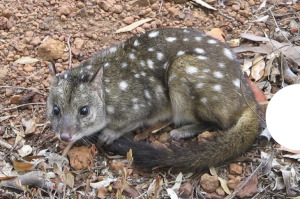
Continuing our series on Australian wildlife with the support of our partner, Dr. Phil Tucak, we explore the Western Quoll, also known as the Chuditch (Dasyurus geoffroii). This striking, spotted marsupial is a vital predator in its ecosystem, and understanding its life cycle and the modern efforts to protect it is key to its survival.
Western Quoll Facts:
- Lifespan: Up to 4 years of age.
- Adult Size: Head and body length of 36 to 46 cm (14 to 18 in.); tail length of 22 to 30 cm (8.7 to 11.8 in.).
- Adult Weight: Males average 1.3 kg (2.9 lb.); females average 0.9 kg (2.0 lb.).
- Breeding & Development: Following a gestation period of 16 to 23 days, litters of 2 to 6 young live in the mother’s shallow pouch. They move to a den between 7 and 15 weeks, becoming independent at 18 weeks and sexually mature at one year.
- Diet: A carnivorous diet including birds, reptiles, small mammals, and large invertebrates such as spiders and insects.
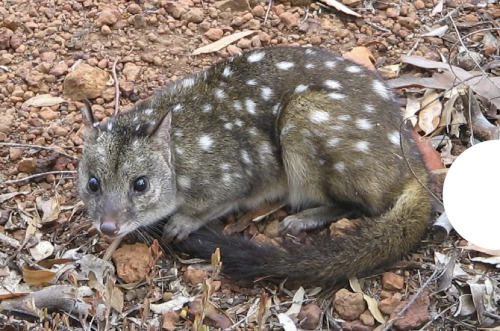
The Western Quoll is the largest endemic carnivorous marsupial in Western Australia, though its current wild population is now primarily confined to the state’s south-west. Primarily nocturnal and solitary, the Chuditch is easily recognized by its white-spotted brown coat and long tail. It differs from the eastern quoll by having a first toe on its hind foot and a noticeably darker tail. Currently, the species is classified as “Near Threatened” on the IUCN Red List—a status positioned between “Least Concern” and “Vulnerable”—highlighting the need for consistent conservation vigilance.
Survival for the Chuditch is threatened by several factors, most notably the introduction of predatory species like foxes and feral cats. Habitat loss and fragmentation due to land clearing and inappropriate fire regimes also pose significant risks. Furthermore, these marsupials face “hidden” threats, such as rodenticide toxicity from eating poisoned prey, as well as accidental drowning in water tanks, illegal shooting, and vehicular trauma.
Protecting the Western Quoll requires a sophisticated, tech-driven approach to conservation. Organizations such as Western Australia’s Department of Biodiversity, Conservation and Attractions (DBCA) and the Australian Wildlife Conservancy utilize motion sensor camera traps as an integral part of their monitoring protocols. These tools allow for efficient, non-invasive data collection, helping researchers track key populations and better understand their ecological requirements. By leveraging this technology alongside breeding programs at the Taronga Western Plains Zoo and the efforts of the Chuditch Recovery Plan, we can better ensure a stable future for this unique species.
To learn more:
- Safe Home for Birds (Rodenticide Info)
- WA Department of Biodiversity, Conservation and Attractions
- Taronga Conservation Society Australia
- Dr. Phil Tucak
Article credits: Dr. Phil Tucak
References:


