
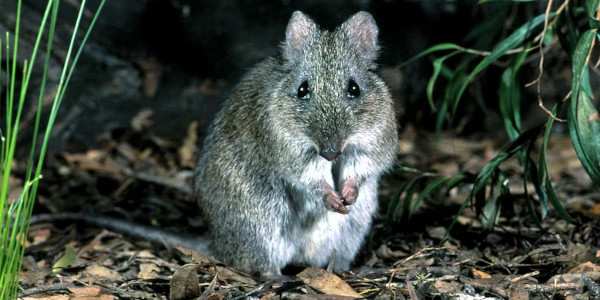
First recorded in 1840 by the collector John Gilbert, from whom it takes its scientific name, Gilbert’s Potoroo was once thought to be extinct. Today, it holds the critical distinction of being the world’s rarest marsupial and Australia’s rarest mammal. Let’s take a closer look at this unique and critically endangered species.
Physical Characteristics
As the smallest member of the kangaroo family, the Gilbert’s Potoroo is a petite animal. Adults have a head and body length of 270 to 290 mm (averaging 9.8 inches) and a tail length between 215 to 230 mm (8.5 to 9.1 inches). Their weight is typically between 708–1,205 g for females and 845–1,200 g for males. With an estimated gestation period of 38 days, females are typically able to have only two babies per year, a slow reproductive rate that presents challenges for population recovery.
Habitat and Ecological Role
The entire known wild population of Gilbert’s Potoroo is found in just a few small pockets on the south-western coast of Western Australia, specifically on Bald Island (off Albany) and Middle Island (off Esperance).
Despite their small size, these potoroos are vital ecosystem engineers. Their digging aerates the soil, which improves water penetration and creates small divots that trap leaf litter, assisting in plant germination. As they dig for their food, which includes truffle-like fungi, they spread fungal spores throughout the environment. These fungi form beneficial relationships with plants, aiding in nutrient transfer and promoting overall plant health.
On the Brink of Extinction
The International Union for Conservation of Nature (IUCN) Red List classifies Gilbert’s Potoroo as critically endangered. As of 2022, the wild population was estimated at a fragile 100 to 120 individuals. They are tragically one of 63 Australian species considered likely to go extinct by 2041.
The species faces numerous threats, including environmental fires and predation. They are also susceptible to various diseases, such as balanoposthitis and cryptococcosis, and have proven difficult to breed in captivity. Conservation techniques, such as physical translocation to areas protected from feral animals, are a key part of the strategy to save them.
Learn More and Support
To learn more about this incredible animal and support the critical conservation efforts to save it, please visit the Gilbert’s Potoroo Action Group online.
- Website: https://www.potoroo.org/
- Facebook: @gilbertspotorooactiongroup
- Twitter: @gilbertspotoroo
- Instagram: @gilbertspotoroo
- YouTube: @PotorooOrg
Article credits: Dr. Phil Tucak, https://www.philtucak.com/ Reference: https://en.wikipedia.org/wiki/Gilbert’s_potoroo


